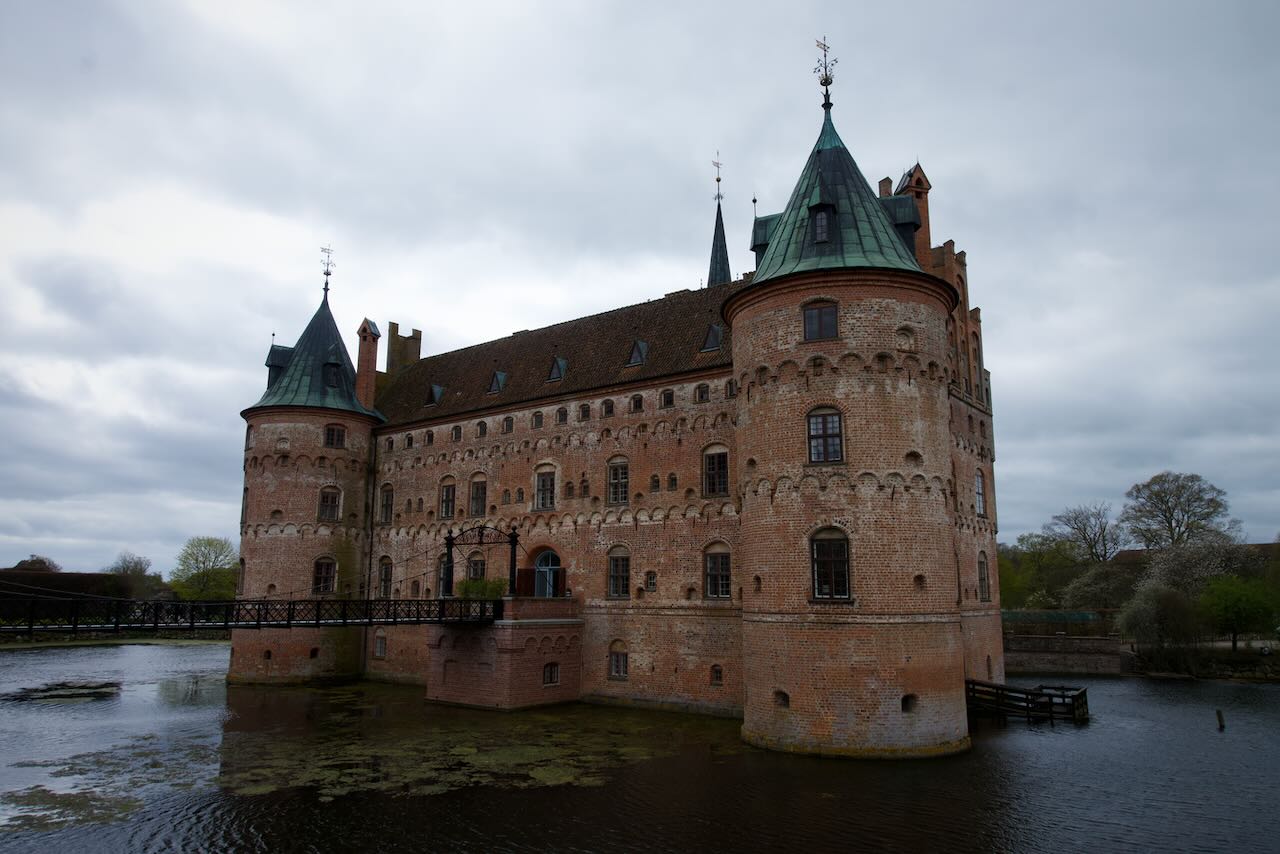
From the 20th of April to the 27th of April 2026, I went on a holiday trip to Denmark. Just like with my trip through the Netherlands, I wanted to publish a journal about my experiences, and share some of the photos that I took.
Here we go!
Sunday, 19 Apr 2026 - Day 0
Tomorrow is the start of my trip to Denmark. I will begin my journey by traveling to Hamburg with a stop in Bremen. I have spent a lot of time preparing and arranging things, but now the time has come to execute all those big plans of mine. “What have I gotten myself into?” is one of the thoughts going through my mind.
I especially don’t like the idea that I “have” to leave. Everything has already been booked, so I don’t have the option to postpone things. Not that I would do such a thing, but I don’t like that I don’t have the option to do so. I do, however, know these feelings will subside once I’m on my way.
I am most anxious about the first few days. I will be staying in a hotel in Hamburg for the first two nights. I never really liked hotels. You only have a small room and are forced to eat in restaurants.
After these two nights, I will continue my journey to Denmark. I have booked a vacation home in Sorø. This should be far more relaxing, because you can enjoy breakfast and dinner by yourself and do things at your own pace.
We shall see how things work out.
Monday, 20 Apr 2026 - Day 1
Today is the first day of my holiday in Denmark. I decided to record my journal entries in an audio format and transcribe them to text when I get back home. This is quicker than typing them out like I did during my journey through the Netherlands in 2024. Typing out the journal entries during my trip took a considerable amount of time every day. This was time that I couldn’t use to relax.
Besides the new journaling system, I fully intended to apply the lessons learned from my first journey to this one. One important change was the reduction in weight. No camping and hiking gear this time. I also brought my Nikon Z50 instead of my Nikon Z5. The Z50 is smaller and especially lighter than its bigger brother.
Driving on the German roads was a new experience for me. The first thing I noticed was that the Germans combine what we in the Netherlands refer to as 80-roads and N-roads. 80-roads are meant to connect small towns and villages. The speed limit for these roads is set at 80 km/h and you can encounter slow-moving traffic such as tractors and other machinery.
N-roads connect larger towns and cities. They have a speed limit of 100 km/h and you usually leave and enter them by using on- and off-ramps. Slow-moving traffic is not allowed to use these roads, so it’s just cars, vans, trucks, and motorcycles. The names of N-roads all start with the letter “N”.
The Germans seem to have combined the characteristics of 80-roads and N-roads, creating a mishmash of road infrastructure. The speed limit is 100 km/h, but you also share the road with slow-moving traffic. Sometimes you have on- and off-ramps, other times you have traffic lights, and sometimes roads just directly connect to the main road.
Things felt more familiar once I got to the Autobahn. Getting onto it felt exciting since the on-ramps in Germany are shorter than in the Netherlands. It turned out that it wasn’t really something to worry about, though. Germans tend to be more proactive in making room for merging traffic.
But why, though? Why are the on- and off-ramps so short? There is enough space, so why not make them longer so people have more room to safely merge onto the freeway and slow down after leaving it? My best guess is that it has to do with the way things have always been done. As time passed, cars became faster, but the infrastructure was never adjusted to accommodate the higher speeds.
And while we are on the topic of speed, what’s the deal with the unlimited speed limit? Most Germans drive around 120 km/h, but then you have people in flashy cars driving at insane speeds. My first thought was how much these people must be spending on fuel costs, since fuel isn’t cheap in Europe. It didn’t take long after this for me to witness my first “almost rear-end collision”, when a Volkswagen Golf had to brake very hard in order to avoid crashing into a car that had switched to the left lane to overtake a truck in the center lane, which was, in turn, overtaking another truck in the right lane. The risk-reward ratio doesn’t seem worth it.
That’s enough about the road infrastructure (for now). After some driving, I arrived at the Weserstadion in Bremen and parked my car in the car park in front of the building. After making use of the stadium’s free restroom facilities, I started making my way to the old city center on foot. It was still raining a little, but luckily not as much as during the car ride.
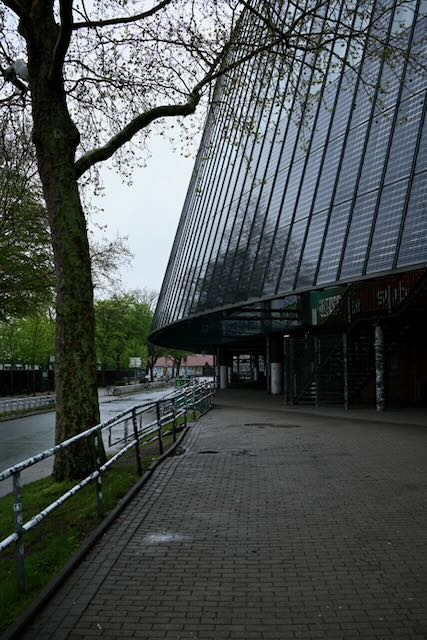
The entrance of the Weserstadion
Bremen reminded me of Manchester. It had many of the same elements. You had a blend of old and new architecture, graffiti, homeless people, and a high police presence. The historical city center was nice but felt a bit empty, since there was lots of space between the buildings. I took a walk through the famous Böttcherstraße and made my way back to the stadium. There was little time to see anything else.
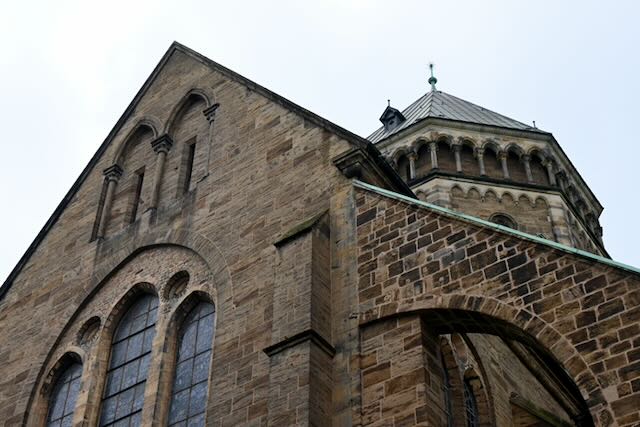
The back of the St.Petri Dom Kirche in Bremen
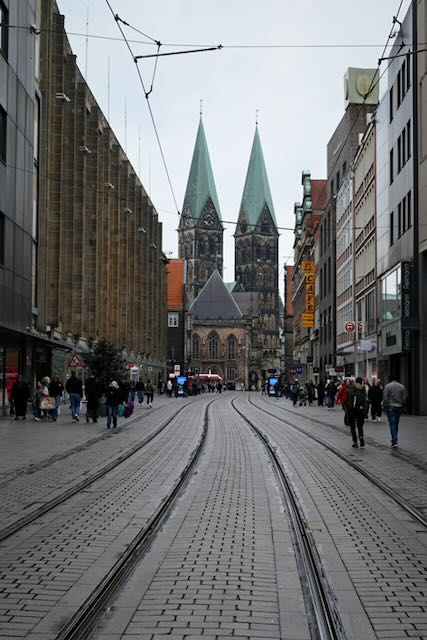
Tram rails leading to the St.Petri Dom
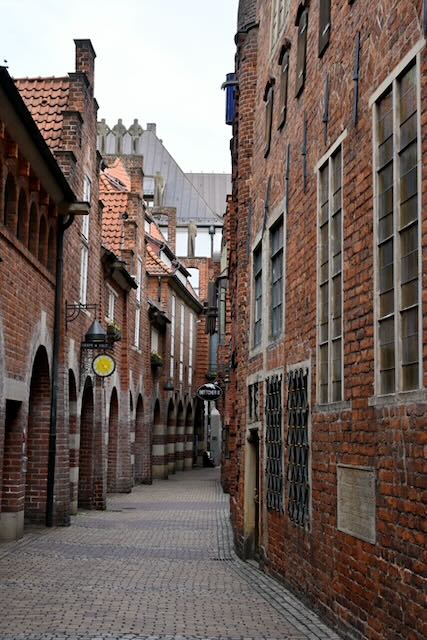
The Böttcherstraße in Bremen
My trip to Hamburg went without any problems. I arrived at Hotel Schmidt and got the key to my room. The hotel rooms were spread out over different buildings. Luckily, mine was in the main building. After taking some time to relax in my room, it was time to have dinner. I would have rather kept relaxing, since I was tired from my journey and would rather have had the evening to myself, but I was also hungry.
I decided to go to the AKAI Japanese restaurant. It wasn’t a large restaurant and all of their tables were already reserved when I arrived there, but they had seats open at the bar. One of the perks of solo travel is that there is always extra room for at least one person. I sat down at the bar and ordered the miso soup and Hanchen Bowl.
The soup was delicious and the bowl was well prepared. I had some experience using chopsticks before, but I had only used them for sushi. It took some effort, but I managed to finish the rice bowl using only chopsticks. Great success! Communicating with the staff was difficult, but I managed.
I learned some German in school and made some effort to brush up on my knowledge beforehand, but actually speaking the language is something different. I could understand what they were saying to me, even though I didn’t understand every word. I did, however, struggle with pronouncing the right words even though I knew what to say.
At least the staff appreciated my efforts. They were young people, so I probably could have used English as well. But I made the effort to communicate in their own language. After paying the bill and wishing the staff a “Guten Abend”, I made my way back to the hotel room.
I did well today. I drove in a foreign country, practiced my German, and ate a rice bowl with chopsticks. Tomorrow I will have the whole day to explore Hamburg. I’m looking forward to it.
Tuesday, 21 Apr 2026 - Day 2
I woke up in the morning, had breakfast at the hotel, and went to the S-Bahn station Othmarschen, which was just across the street. I struggled a bit with getting the right travel tickets since there were so many options at the ticket machine. I got on the metro and soon arrived at Altona station.
Just before arriving at the station, a man gave a little speech and went around the train with a cup in his hand. I do feel bad for those who need to beg for money to survive, but it is my policy not to give them anything, since I don’t know what they are going to do with the money. Is it to buy water and bread, or are they going to buy drugs or alcohol? These people need help from organizations that can get them out of their situation.
It took some time to orient myself after leaving the station, but after booting up my Garmin Montana and loading the Hamburg Citywalk track, I was on my way. I noticed some Roman-style architecture, passed by a large fountain, and took a picture of the Altonaer Theater.
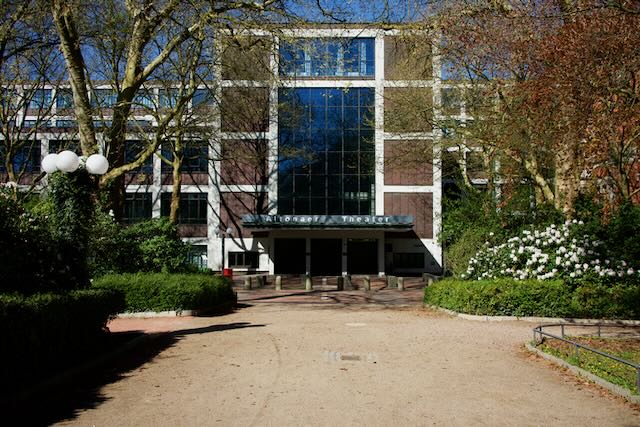
The front entrance of the Altonaer Theater
I slowly made my way to the harbor, walked by the many fish restaurants, and eventually ended up at the museum ship “Rickmer Rickmers”. The ship was built in the year 1896 as a steel sailing vessel. It first served as a freighter under the German flag, but was confiscated by the Portuguese during the First World War.
The Portuguese used the ship for training, but it eventually ended up in a port near Lisbon where it gradually fell into disrepair. The vessel was towed to Hamburg in 1983 and restored to its former glory. It has been a museum ship ever since. Besides being a museum, the Rickmer Rickmers also houses a restaurant and a conference room.
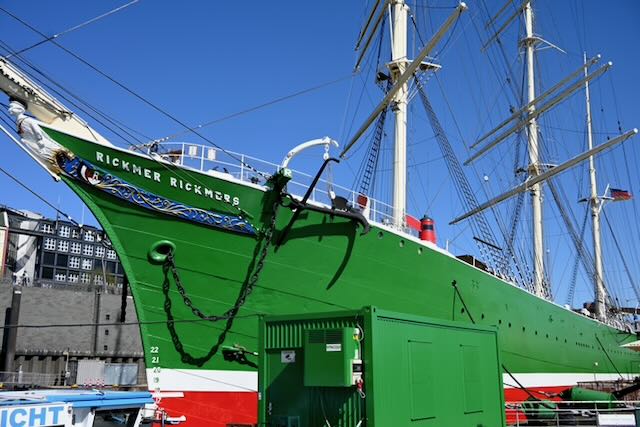
The Rickmer Rickmers
I had fun exploring the different decks and checking out the exhibitions. After my visit, I had a bite to eat at the restaurant next to the ship. I was quite hungry at this point. It was 15:00 hours and I had last eaten around 10:00 hours at the hotel. One thing I love about the Germans is that they know what a good meal is. You get a full plate of food, while in the Netherlands you are lucky to get two slices of bread.
I took a nice photo of the Elbphilharmonie concert hall and paid a visit to St. Michaelis Church. My journey eventually ended at Hamburg’s Rathaus. My initial plan was to walk all the way back to Altona station, but it was already 17:00 hours at that point, so I called it a day and took the S-Bahn back to Othmarschen.
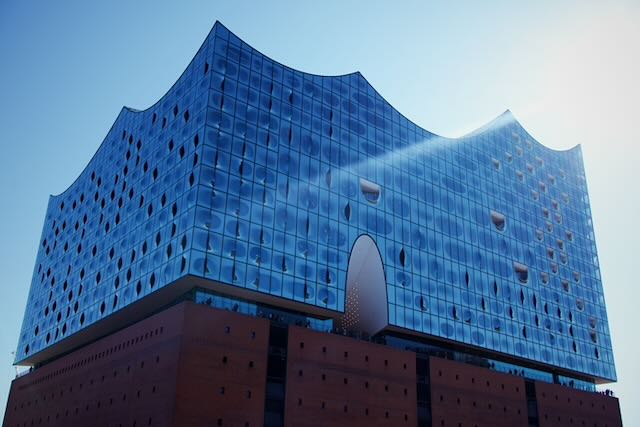
Elbphilharmonie concert hall
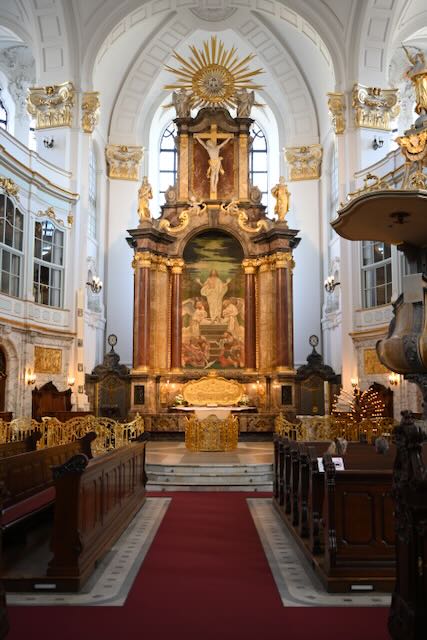
St. Michaelis Church interior
Another person made the rounds with a paper cup on my return journey. This time it was a young woman. Homelessness seems to be a recurring topic in my journals. While making my way to the concert hall today, I even walked onto a film set. They were recording a scene where a homeless person underneath a bridge was being taken away by police officers.
I never expected the number of homeless people to be so high in Germany. You expect it from countries like England, where it is known that there is a high level of poverty outside the major cities like London. It does make you more appreciative of the fact that you have a roof over your head tonight and don’t have to worry too much about money.
After arriving back in Othmarschen, I relaxed in my hotel room for a bit and ate a burger at the joint across the street. I was surprised when I discovered that the screens where you place your order were in English. Normally, the Germans translate everything into their own language. I even looked around for a language selection button, thinking that the previous user had left it set to English. There was no language selector. I was truly amazed.
I placed an order for a Caesar Burger, and after a short wait, ate it at one of the tables. I just ordered the single burger with no extras, since I had already eaten a large meal earlier. The burger was alright. I have never been a big fan of fast-food restaurants, since you often leave hungrier than when you came in.
Tomorrow I travel into Denmark. I have enough fuel for 260 km, so I need to fill up soon. I looked at the map and spotted a gas station close by, but it was on the wrong side of the road. I would need to make a U-turn at a traffic light, get to the station, and make another U-turn again. That was going to take up too much time, so I found a gas station outside Hamburg, just off the freeway. I added it to the route as a stop. My navigation system should lead me there tomorrow.
Wednesday, 22 Apr 2026 - Day 3
I woke up, had my breakfast, and turned my room key in at the reception desk. Then I made my way to my car and put my stuff in the trunk. It wasn’t too busy on the road and I quickly arrived at the Familia gas station, which was located in a large parking lot. I had to wait in line, but I wasn’t too bothered by it.
After filling up and paying, I wanted to proceed to the next destination. My navigation system had other plans, though. It wasn’t convinced that I had visited the gas station and tried sending me back. I had quite enjoyed using my Garmin Montana for driving and city walks, but this was one of my biggest annoyances with the device.
There is also no way to manually override this behavior and tell the device to lead me to the next stop on the route. Instead, I have to park the car, stop the navigation session, then find and select the next destination, and start a new route to it. Situations like these really make me feel like the people who design these things don’t actually use them themselves.
I even went so far as to file a complaint with Garmin Support in the past, because I think this is an option that should simply be included. The complaint led to nothing, of course, but I had to at least try.
After my fuel stop, there was still some driving left to the German-Danish border. I was quite surprised that there was a border checkpoint. This is the second checkpoint I passed through, the first one being on the Dutch-German border. I was a bit annoyed by it, since the whole idea of the Schengen Area is to allow a free flow of goods and people, and here I was, standing in line to cross the border.
The Danish road network is easy to navigate. I entered the country on the E45 freeway and later transferred to the E20. The E20 then brought me all the way to Odense. The on- and off-ramps on Danish highways are even worse than the ones in Germany. Not only are they short, but you can only merge at the end of the lane and leave at the start of the lane, which doesn’t give you much flexibility.
You can clearly see the effects in the behavior of the drivers. Cars slow down significantly before taking their exit. Drivers are also more actively switching lanes to let others merge. There are even road signs notifying people on the freeway about upcoming on-ramps. This is different from the situation in the Netherlands, where the initiative is mostly in the hands of the merging driver, not the cars already on the freeway.
Once I entered Odense, I was also confronted with something that I had not seen in a long time: traffic lights with no separate signals for left- and right-turning traffic. This meant that you had to wait in the middle of the intersection if you wanted to cross the flow of traffic in the opposite direction. The strange thing was that there were dedicated lanes for left- and right-turning traffic; there were just no separate traffic lights for these directions.
Why would they do such a thing? How uncivilized. Yes, you have to add extra lights and an additional turn for cross-traffic, but it makes things much safer. It won’t even cost you any extra time if you put pressure sensors underneath the asphalt and skip the turn if there are no cars waiting. Situations like these make me realize how utterly spoiled I am by Dutch road infrastructure, but we also have a much larger population living on a smaller landmass. We therefore have to be efficient.
I parked my car and checked in at the parking meter. I always appreciate such a system, as opposed to one where you have to pay for a fixed number of hours upfront. You don’t have to worry about returning before a certain time.
The city of Odense felt quite peaceful. People were relaxing in the local park. I paid a visit to St. Canute’s Church. Its interior was much simpler than that of St. Michaelis Church in Hamburg, but I didn’t see this as a bad thing. The church felt more welcoming as a result.
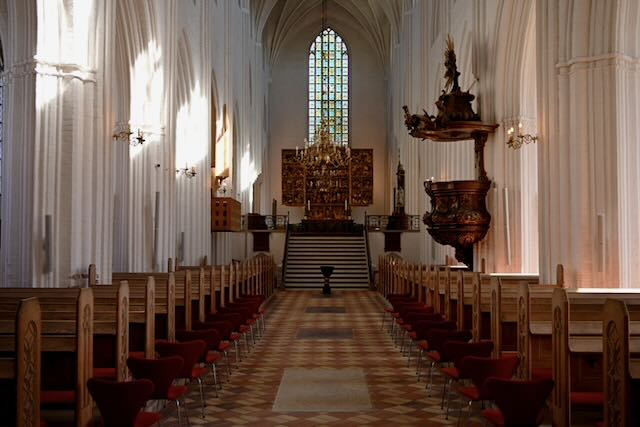
St. Canute Church interior
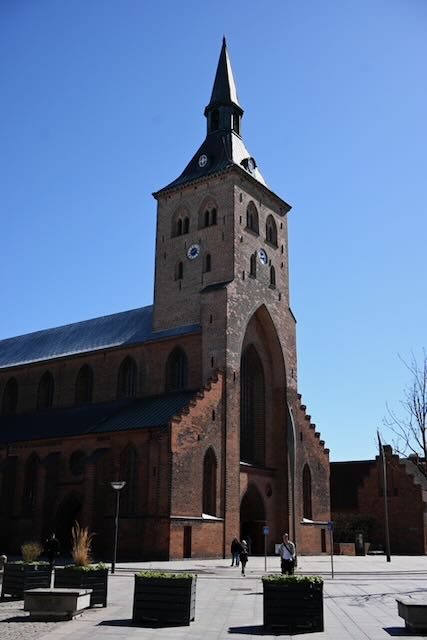
St. Canute Church front view
As I walked the streets, I noticed that there was a lot of empty space between the buildings. This empty space was, however, filled with concrete and stone. It gave things a sterile look. “It must get hot in here during the summer, with nothing to provide shade or absorb the heat,” I said to myself.
After some exploration, I made my way to the Cultural Museum of Odense. I actually entered the museum grounds through the back gate and couldn’t find the ticket building. I ended up entering the administration building and got directions to the entrance from someone there.
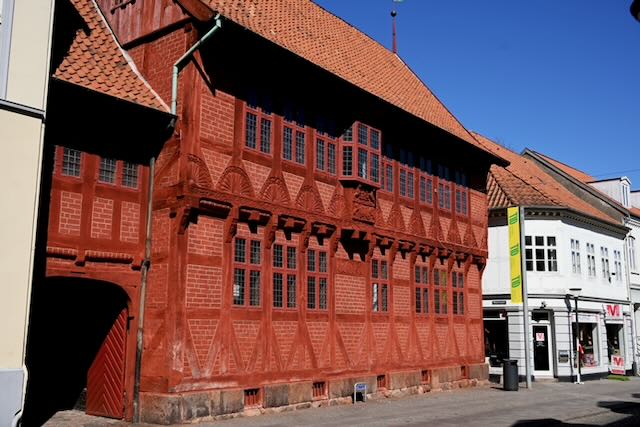
The back entrance of the Odense museum
The main building housed two exhibitions, and the rest were spread out through the different buildings on the grounds. I enjoyed going from building to building to see what was inside. It was a great place to learn about the history of Denmark. Sadly, I didn’t manage to visit all the buildings before closing time.
There was still a part of the walking route left, but I had had enough at this point. It was 4 o’clock, and I still had an hour’s drive ahead of me. I took the shortest route back to the car park and left Odense.
Sorø was located on the second island (Zealand), and this meant that I had to use a bridge to get there. The Great Belt Bridge can be seen as two connecting bridges with a small island in between them. There is a lighthouse located on the island.
I still remember crossing the first bridge and seeing the lighthouse with the second bridge in the background. Such a beautiful sight. I would have loved to take a photo of it, but I had to keep both hands on the steering wheel. There was also no opportunity to stop somewhere, so I decided to just enjoy the sight while it lasted.
The fun couldn’t last forever. After enjoying the sights on the bridge, I had to pay the toll. It cost around 13 euros to cross the bridge. An expensive fee, considering I have to cross the bridge two more times this week.
Soon after crossing the bridge, I arrived at the Lidl supermarket in Sorø. I bought the things I needed and continued on to the vacation park. Once there, I was assigned a hut close to the entrance. I could park my car next to the hut, which is not always a given. Once inside the hut, I felt a sense of relief. I finally had a place to myself.
I had initially planned to visit Copenhagen by train tomorrow, but I was questioning whether this was a wise decision. I had already visited Bremen, Hamburg, and Odense, and I had grown tired of cities at this point. I was still in doubt and decided to view the route that I was planning to take in Google Street View.
I saw mostly steel, glass, stone, and concrete, and I even got a bit nauseous looking at it. I had made my decision. Tomorrow would be a rest day. I had seen enough large cities and would focus on visiting smaller places from now on.
Thursday, 23 Apr 2026 - Day 4
Rest day. Nothing noteworthy happened.
Friday, 24 Apr 2026 - Day 5
Time to get on the road again! Today I planned to go to Frederiksborg Castle, with a stop in the city of Roskilde. The navigation system told me to get on the freeway, but the on-ramp in the direction I needed to go was closed off. I therefore decided to take the provincial road to Roskilde instead.
I was greeted with beautiful scenery and traveled through several small villages. It was a great way to see some of the countryside instead of traveling on dull freeways. After about an hour of driving, I arrived in Roskilde. I had to find a spot in the parking lot at Roskilde Harbor. This proved a bit challenging, since parts of the lot were closed off for storing small boats. I eventually found a spot and went to the first order of business: visiting the local historical museum.
The museum in Roskilde was nice and cozy. It had different rooms, each with its own theme. The first room was about racing, because the town used to have a race track. I took some time to watch the old video footage that was being shown.
There was also, among other things, a room with archaeological finds, a recreation of an old classroom, a room with items related to the Second World War, and a room with commemorative shooting disks. These disks used to be trophies given to the winners of shooting competitions. Shooting clubs were initially created to prepare the civilian population for war, but as time passed, these clubs lost their military purpose.
It was also interesting to learn that Roskilde was the original capital city and the trade and religious center of Denmark. The relocation of the king to Copenhagen in the year 1443 sparked the steep decline of the city. Many religious institutions also disappeared after the Reformation.
After my museum visit, I walked by Roskilde Cathedral and took some photos of the exterior of the building. It was an impressive structure. I would have loved to look inside, but I had to move on to the next destination. I wanted enough time to see Frederiksborg Castle, so I went back to my car and resumed my journey.
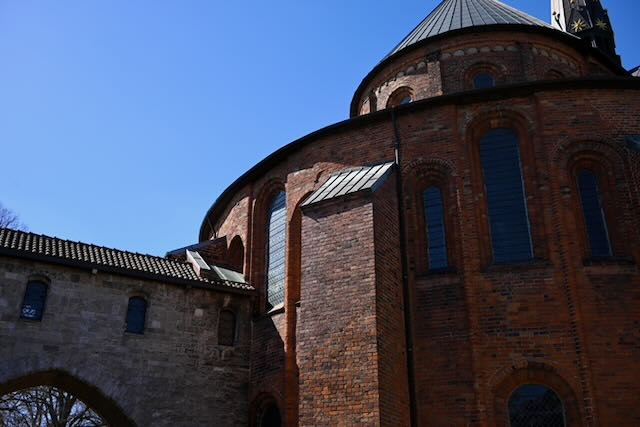
The back of the Roskilde Cathedral
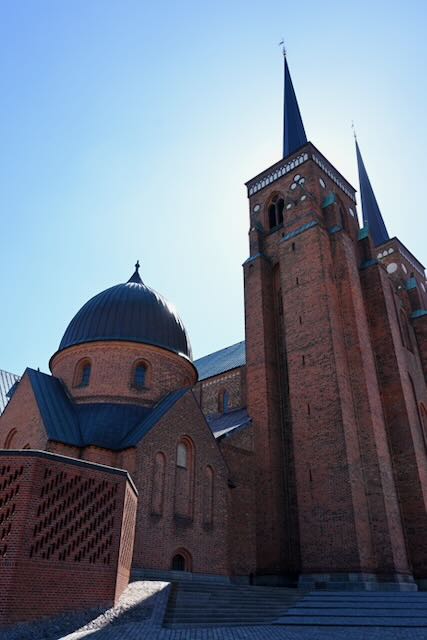
The front of the Roskilde Cathedral
About an hour later, I found myself parked in a parking space at the back of the castle. Frederiksborg has two parking areas: one at the front and one at the back. The one at the front is close to the entrance, but it is paid parking. The one at the back requires a walk through the castle grounds, but it is free to use.
I grabbed my food jar from the trunk of my car and enjoyed a well-deserved meal before strolling to the entrance. Frederiksborg is a large castle. The building has a U-shape with four floors to explore.
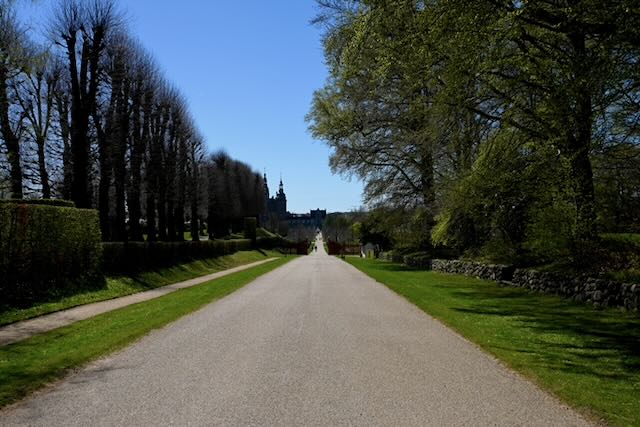
The back entrance of Frederiksborg Castle
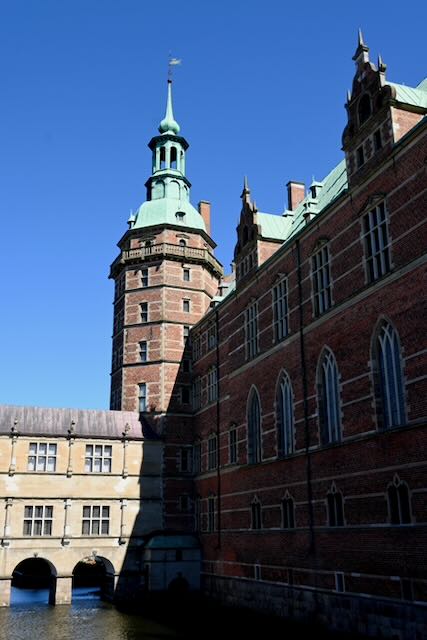
A side view of Frederiksborg Castle
The tour started with the church. After this, I moved on to a more general section from where you could also visit the audience chamber of the castle. The tour covered two-thirds of the first floor (with the ground floor being the entrance level). I was guided to a staircase that brought me to the second floor.
Here I got to see the Great Hall, which was filled with an exhibition about tapestries. After this, I was free to explore the whole floor, which covered the time periods 1650–1700 and 1700–1850. The tour eventually led to a staircase where I had the choice to go either up or down. I chose to go up to the third floor.
The top floor covered the period from 1900 up to the present day. After finishing that floor, I was confused about where to go next. I ended up taking the closest staircase back to the entrance, from where I left the building. Later on, after carefully studying the floor plan, I discovered that I should have taken another route.
Instead of taking the staircase up on the second floor, I should have used it to go one floor down to the first floor. There I would have had the opportunity to see the missing one-third of the floor that I had skipped earlier. Then I should have used a different staircase to go all the way to the top, explore the third floor, double back to the staircase I had used to get there, and then go all the way down to the ground floor.
There I could have explored some temporary exhibitions, gone past the souvenir shop, and taken the staircase to the cellars. Oh, and at the entrance I had walked past another room with a temporary exhibition, so I should have visited that one as well.
Oh well, I should have looked at the floor plan more carefully at the start of the tour. It is, however, a good excuse to visit the castle a second time. In my experience, you have to visit a museum at least twice to truly see it all. During the first visit, you are often overwhelmed by everything and have to constantly orient yourself. During the second visit, you know what to expect and where to go, and can therefore focus more on what is on display.
The drive back to the vacation home went without any major problems. I had to create a custom route on the navigation system in order to force it to guide me back through the provincial roads instead of the freeway, which would have taken me through Copenhagen. I wanted a relaxed ride, even if it took a little more time.
Saturday, 25 Apr 2026 - Day 6
Today I was going out to visit a special place: Egeskov Castle. In the morning, I ate breakfast, got in my car, and went on my way. I was in a relaxed mood. No multi-stop journeys today. Just get to the castle, see the castle, and head back. It was quite cloudy and windy, though. I especially noticed the side winds while driving on the Great Belt Bridge.
The number of motorcycles on the road increased the closer I got to the castle. There seemed to be some kind of event taking place there. I parked my car in the parking lot in front of the castle and made my way to the entrance. I had to stand in line at the ticket desk, but eventually entered the castle grounds.
This wasn’t my first visit. I have visited the castle twice in the past. This would be the third time. My previous visits were during family holidays with my parents, grandparents, and younger sister. The last time was in the year 2013. I was 18 years old at the time, in the second year of my bachelor’s degree.
And now, 13 years later, I was here by myself. It felt nostalgic. It was a lot busier than during my previous visits, though the weather was the same. I saw a lot of people in motorcycle gear who had to be part of the event.
I took a look at the map and decided on the route I would take. I would start with the Sun Garden, then visit the castle itself, followed by the castle park, after which I would make my way to the large barns where the majority of the exhibitions were located.
The castle itself wasn’t that large, and you can only view part of it. There is a single staircase that provides access to several floors. Everything looked the same as during previous visits, but I noticed that a wall in one of the hallways had been painted blue. It had been white during my previous visits.
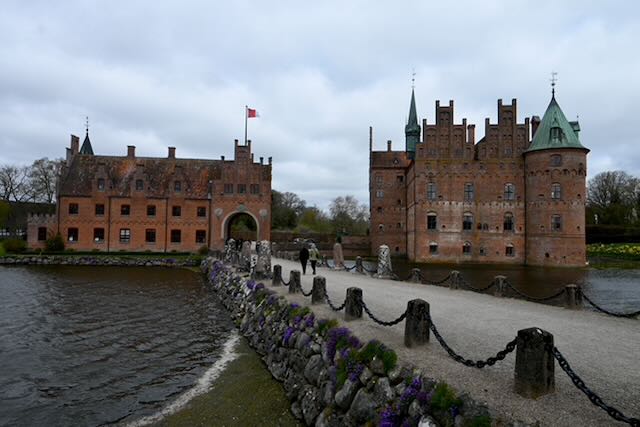
The entrance to Egeskov Castle
I also tried to recreate one of my favorite pictures, which is a photo of one of the windows in the staircase. It wasn’t a great success, since there was a different pan in the window frame, which meant that I couldn’t recreate the same composition.
It was nice and quiet in the castle park. I had the opportunity to photograph the castle from different angles. There was a maze there, but it was closed off.
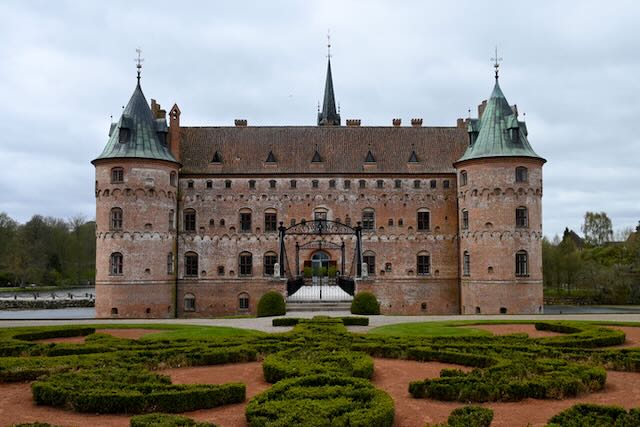
The front view of Egeskov Castle
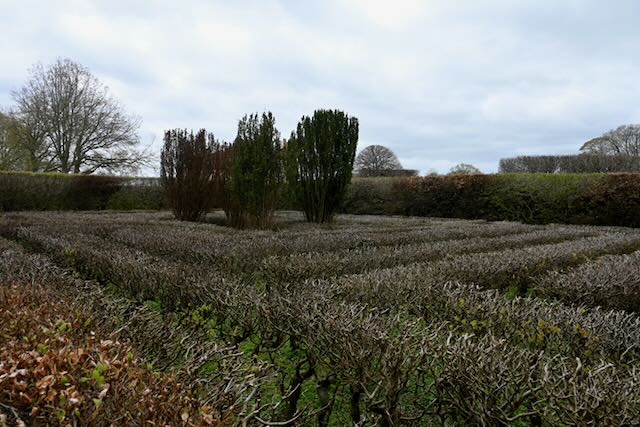
The maze in the Egeskov Castle Park
After my visit to the park, I slowly made my way to the main attraction. There was a large barn that housed all kinds of classic cars and motorcycles. It was probably the main reason why all those motorcyclists were there. It was busy when I arrived.
I discovered that they had expanded their collection quite a bit. The tour started with all kinds of classic cars from different time periods. They had a Ford Model T, but also an old Aston Martin, a DeLorean, a British double-decker bus, a whole bunch of mopeds, and even a helicopter. There were also lots of different motorcycles on display, and there were separate areas that housed the Rescue Museum and the Camping & Outdoor Museum. I also found the “Dracula Cave”, which was the only thing that felt unchanged compared to my previous visit.
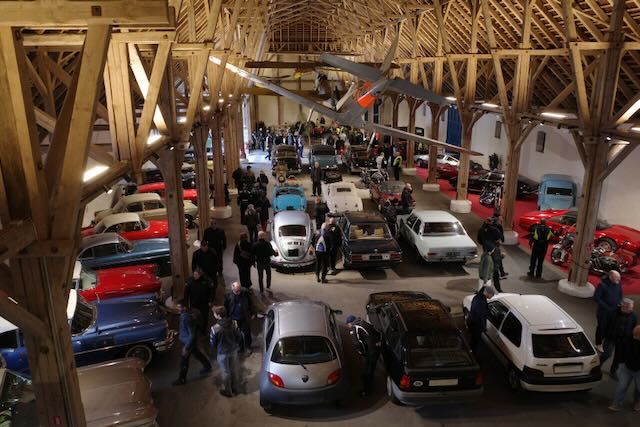
The Egeskov Museum
The Outdoor Museum had all kinds of tents and caravans on display. There were also some other vehicles that had been converted into campers by their owners. It was interesting to see the different tent designs. There were also different types of caravans, including one designed for outdoor use and a compact caravan.
I also saw models where the walls were made of fabric, allowing you to collapse the roof during transport. There also exists a model where only the top section of the walls are made of fabric. This allows you to lower the roof to reduce wind drag while still having glass windows. I didn’t see an example of such a caravan in the museum, however.
The Rescue Museum housed all kinds of fire trucks and ambulances. I even saw the same model ambulance that was used in the Ghostbusters movie. There was quite a collection, and even an adjacent garage with more vehicles.
After finishing the tour in the Rescue Museum, it was time to call it a day. I had seen everything. On the way back, I stopped at a gas station to fill up the car and paid a visit to the supermarket in Sorø to buy a few small things.
This was it then. Tomorrow is a rest day, and I have my journey back to the Netherlands the day after. I am grateful for the opportunities I had during this vacation. I visited many places and saw many things.
I noticed that I wasn’t charged for my two trips over the Great Belt Bridge. Maybe you only need to pay once and can then use the bridge for a week without incurring extra costs?
Sunday, 26 Apr 2026 - Day 7
Rest day. I relaxed for most of the day, but also took some time to pack my bags and do some cleaning. I did whatever I could today so I wouldn’t have to do it tomorrow morning.
Monday, 27 Apr 2026 - Day 8
I got out of bed and pulled the bed linen off. I then brushed my teeth, did some cleaning, and left the hut. I threw my trash bag into the garbage container on my way to the park entrance. Then I checked out and ate my breakfast at a table in front of the entrance. There are so many things you have to think about. It feels like you are carrying out some kind of military exfiltration operation.
I kept breakfast for last so I could eat in peace with the knowledge that everything had been done. I took my time, since I still had a long journey ahead of me. I would travel back to the Netherlands in a single day. I would take a different route back, though. Instead of going west toward the Great Belt Bridge, I would be going south toward Rødby. There I would take the ferry to Puttgarden and continue my journey by car from there.
I got in the car and made my way to the E20 freeway. I had, however, forgotten that the on-ramp toward Copenhagen was closed off. I therefore couldn’t get onto the freeway in the direction that I needed to go. I had no choice but to take the on-ramp in the other direction and turn around at the next possible opportunity.
This little detour cost me 20 minutes, but I still arrived at the ferry in time. I had booked a ticket for a specific time slot, so I had to be there on time. My ferry would depart at 12:20 hours and I arrived at the departure area around 11:20. Luckily, there was room on a ferry that left earlier. I only needed to wait 20 minutes or so.
The ferry ride was around an hour, which gave me plenty of time to grab a bite to eat, use the restroom, and explore the ship. I took some photos on the observation deck and found a place to sit. The hour went by quickly and the announcement was made for passengers to return to their vehicles.
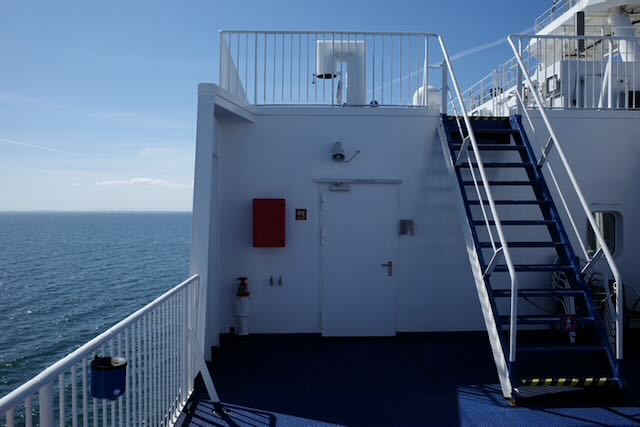
A view from the ferry to Puttgarden
The ride from Puttgarden to Hamburg was relaxing, since there wasn’t a lot of traffic on the road. Things started getting more congested when I got close to Hamburg. Luckily, I did not need to take any off-ramps in that area and could therefore drive in the left lane, where traffic moved along a little more quickly.
There was also some slow traffic near Bremen, but it didn’t cause me too much trouble. Then, for the last part of the journey, I traveled with the Truck-kun Express. There were enough impatient Germans pulling all kinds of stunts to overtake the slower trucks on the two-lane road, but they just got stuck behind the next truck.
I was tired and not in a suicidal mood, so I simply accepted my fate and drove along with my trucker friends. I would get home eventually. I stopped at a gas station just before crossing the German-Dutch border. Fuel is a lot cheaper in Germany. It was a small unmanned station located in a deserted industrial area.
I arrived back home around 18:00 hours.
Closing words
My vacation to Denmark was a great success! It was my first time driving on German and Danish roads. I had also learned from my journey through the Netherlands and packed more lightly. I had the opportunity to practice my German and visit many places.
I saw Bremen, Hamburg, Odense, and Roskilde, and visited Frederiksborg and Egeskov Castle. There is, however, still plenty left to see on a second trip. I would like to visit the Historical Museum in Hamburg, the Viking Museum and Cathedral in Roskilde, and Frederiksborg and Egeskov Castle again.